When we invest in the stock market, as sensible long-term investors, we generally expect returns in the range of 15–25% CAGR. And honestly, such returns are very much achievable over long periods.
However, market history clearly teaches us one important lesson:
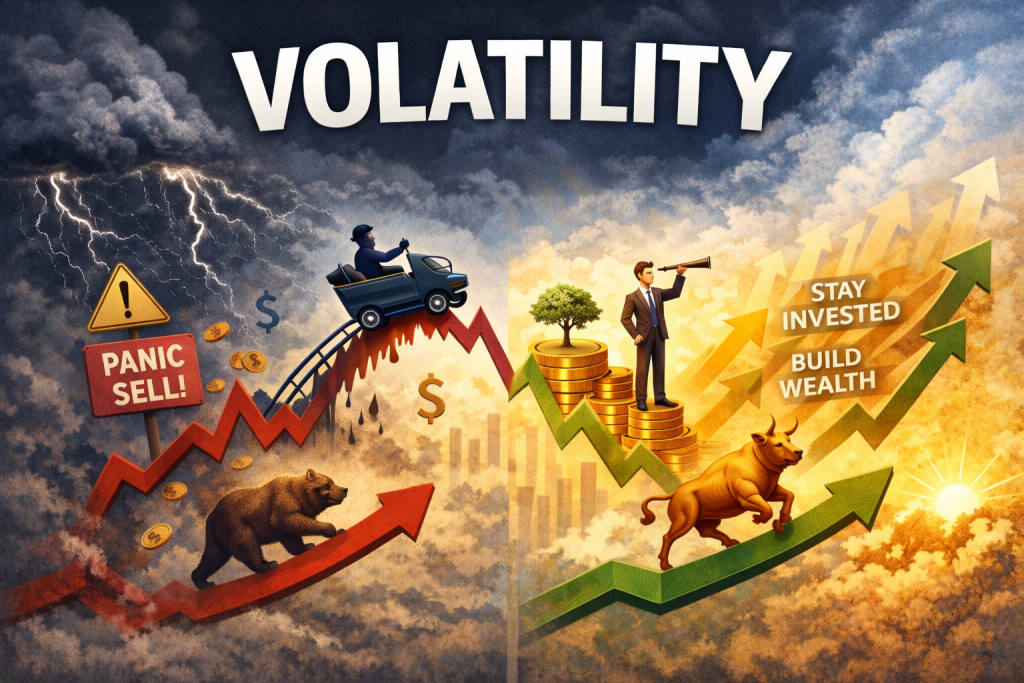
these returns come only if an investor is willing to go through volatility—fully and patiently.
In bull markets, we feel excited and confident. In bear markets, we feel sad, uncomfortable, and sometimes even panicked. This emotional cycle is human nature. But over time, we as investors evolve. We begin to understand that volatility is not a flaw—it is an inherent and essential part of the market journey.
Why Volatility Is Actually Our Friend
Let’s take a simple example.
In a fruit market, the price of an apple is generally known and stable. Everyone understands its value. This is an efficient market, and hence there is very limited scope to make outsized returns.
Stock markets, on the other hand, are inefficient markets—and that is their beauty.
This inefficiency exists only because of volatility.
If there was zero volatility, there would be no opportunity to generate meaningful wealth from equities. Volatility creates fear, panic, overreaction, and mispricing—and that is exactly what long-term investors benefit from.
Volatility Works Both Ways
Over the last 15–18 months, volatility has largely been on the negative side.
But that does not mean it will remain so forever.
Volatility always exists on both sides:
- Negative during bear markets
- Positive during bull markets
Once negative volatility exhausts itself, positive volatility eventually follows.
And here’s a golden rule that market history has repeatedly proven:
No matter how deep the fall, markets have always made new highs over the long term.
That is why we remain confident that new highs will again be made across all segments of the market.
When Almonds Are Available at the Price of Peanuts
Bear markets are the periods when quality assets get mispriced. When volatility is negative, almonds are available at the price of peanuts. These are the rare phases—once or twice in a decade—when genuine long-term wealth is created.
Mr. Warren Buffet once said:
“Look at market fluctuations as your friend rather than your enemy.”
History Repeats—Even If It Feels Different Every Time
These bad times we will literally miss when we will be near 2028-2030 years. Even though the current corrections of last 15-18 months look too big now, after 5 years it will look way smaller. We have seen biggest of corrections in past like
Dot com bubble in 2001
-Sensex Index fell from 5933 to 2600 a correction of 56%
UPA Election results shock in 2004
-There was lot of uncertainty and panic regarding policies. On 17 may 2004 BSE fell 15.5% largest single day fall
Global Financial Crisis in 2008
Sensex dropped by 61%! From the levels of 21206 in January 2008 it went down to 8160 in March 2009
INR STRESS in 2013
Between May 2013 to August 2013 our rupee depreciated by 15% which created huge volatility in Indian equities alongside outflows!
Credit risk shocks in NBFC space in 2018
We remember that period as IL&FS phase! The company defaulted big time. Liquidity got squeezed and there was huge volatility during those times i.e. 2018-19
Covid crash in 2020
On 23 March 2020 Sensex was down by 13.15% and Nifty was down by 12.98%. Sensex closed at 25981 and nifty closed at 7610! And according to Bloomberg these were the lowest levels since 2016 means all four years gains wiped out!
In above events we have skipped many other events like Russia Ukraine war, UK inflation, demonetisation etc. Even after so many brutal correction phases long term investors have created wealth. Even after so many corrections markets have made new highs again.
Today, when we look back, none of those crashes appear as frightening as they felt at the time. The same will be true for the current phase.
The 500% Tariff Drama – How Practical Is It?
When we talk about the new tariff bill proposed by Donald Trump, it suggests imposing a very steep 500% tariff on countries that continue doing significant business with Russia. Countries like China, India, Brazil and others fall into this category. At first glance, such a proposal appears extremely aggressive and strong, but if we think about it rationally and practically, many questions arise about how realistic and sustainable this move actually is.
The United States today is deeply dependent on global supply chains. It relies heavily on China for rare earth minerals, which are essential for electronics, defence equipment, electric vehicles, semiconductors and clean energy technologies. At the same time, the US imports a large number of pharmaceutical products from India, especially generic medicines and active pharmaceutical ingredients. While it is true that America’s dependency on China is much higher than its dependency on India, India still plays a crucial role in the US healthcare supply chain.
Now, if a 500% tariff was actually implemented, it would significantly raise costs within the US economy. Supply chains would be disrupted, inflationary pressures would increase, and many strategic industries would struggle to function efficiently. The bigger issue is sustainability. If such a tariff is imposed and later the US is forced to reverse or dilute it for China because of unavoidable dependence on rare earths and manufacturing inputs, then on what grounds can the same tariff continue for countries like India or Brazil? This would expose clear policy inconsistency and could result in embarrassment and loss of credibility for the US. Therefore, while the headline sounds powerful, in reality, implementing and sustaining such an extreme tariff is far from easy in a globally interconnected economy.
Shifting the focus to India, the long-term growth story of the country remains very strong, largely independent of short-term global political noise. India accounts for around 18% of the world’s population. While a large population does come with challenges, from an economic perspective it is also a massive asset. A large population creates a large base of consumers, workers and entrepreneurs, which supports long-term demand and growth.
One of the most important structural demand drivers in India is the gradual shift from joint families to nuclear families. Traditionally, India has followed a joint family system, but over time, due to urbanisation, migration, changing lifestyles and employment mobility, families are breaking into smaller nuclear units. When a joint family splits, each new household requires a new home, home loans, construction spending, paint, interiors, furniture, appliances, utility connections and regular maintenance. This creates a chain of continuous expenses, and one person’s expense becomes another person’s income. This process generates long-term demand that can last for decades. To add some global context, in China nearly 25% of households are single-person households, meaning someone lives alone in a house. India is still at a very early stage of this transition, which suggests a long runway for housing and consumption growth.
India also has one of the youngest populations in the world. A younger population naturally spends more, as younger people aspire for better living standards, comfort and experiences. This supports growth across housing, consumer goods, travel, services and financial products. Younger demographics are a powerful long-term economic advantage.
When we look at the global environment, many countries are facing serious challenges. Some are affected by wars, some by violent protests, and in some places, people are deeply unhappy with their governments. Examples can be seen in Bangladesh or countries like Iran, where social and political unrest is high. In comparison, India is far more stable. It is largely a law-abiding and peaceful nation. Even when protests occur, they are mostly constitutional and non-violent, with only a few exceptions. This relative stability is extremely important because it attracts long-term capital, investment and talent.
India is also richly endowed with both human talent and natural resources. The country has an exceptional pool of human capital. We regularly see entrepreneurs building successful businesses from small towns, often with limited access to infrastructure and facilities. Despite these constraints, Indian talent continues to excel across industries. On the natural resources side, India receives sunlight for most of the year, has fertile agricultural land, multiple rivers and most mineral resources, except oil and gas. Agriculture remains one of the strongest pillars of the Indian economy.
Over time, India’s dependence on imported oil and gas is expected to reduce. The country is seeing rapid growth in solar energy capacity, falling costs of battery energy storage and increasing adoption of electric vehicles. As these trends continue, India’s import bill for energy can reduce meaningfully. If the country starts earning more dollars than it spends, the current account deficit can eventually turn into a surplus. In such a scenario, for the first time in many years, we could see the Indian currency appreciating gradually and sustainably rather than depreciating.
A common question that arises is where future demand will come from and how India can continue growing consistently for many years. Instead of answering this directly, it is useful to look at some simple facts. Only about 7.5 to 8% of Indian households own a car, which means more than 90% of families still do not have one, even though India is already considered a large car market. Air conditioner penetration is also very low, with only about 7 to 8% of households owning an AC. Washing machine penetration is roughly 18 to 20% overall, with higher penetration in urban areas and very low penetration in rural India. Microwave ovens are present in only about 20 to 25% of households, largely concentrated in metros. Water purifiers are used by around 22 to 25% of households, while refrigerators are present in only about 38 to 40% of homes. Dishwashers are practically non-existent, with less than 1% household penetration, and clothes dryers are used by less than 1 to 2% of households, as most Indians still air-dry their clothes. These numbers clearly show that India is still at an early stage of the household durables cycle, and even basic comfort appliances are far from being saturated.
If we move beyond products and look at experiences, the gap becomes even more striking. Only about 5% of Indians have ever travelled by airplane, meaning roughly 95% of the population has never taken a flight in their lifetime. Fewer than 10% of Indians have ever stayed in a paid hotel, as most travel still involves staying with relatives or in low-cost accommodations like dharmshalas. International travel is even rarer. Less than 2% of Indians have ever travelled abroad. Passport holders themselves account for only about 7 to 8% of the population, and even among them, many never actually travel overseas. These are among the lowest penetration levels globally.
Formal financial products also have very low adoption. Less than 7 to 8% of Indians invest in mutual funds or similar long-term market-linked products. Equity investors form only a small fraction of the population, and structured wealth creation products are still niche.
The key insight from all this is that India is not just under-penetrated in terms of products, but also under-experienced. As incomes rise, people do not simply buy more goods. They start spending on comfort, convenience, safety, experiences and financial security. This marks a deeper and more sustainable form of consumption growth.
Looking ahead to India’s consumption story over the next decade or more, the country is entering a long cycle where spending gradually shifts from basic needs to comfort, then to convenience, followed by experiences and finally financialization. The growth runway exists because penetration in several aspirational categories such as cars, air conditioners, air travel, passports and formal investments is still very low. At the same time, rising incomes, urbanisation, easy financing and strong digital infrastructure can compress what took other countries several decades into just 10 to 15 years in India.
Replacement Demand V/s Organic Demand
One final concept that ties this entire long-term growth story together is the idea of replacement demand versus organic demand. In many developed economies such as Japan, consumption has largely reached a saturation point. In these countries, most households already own cars, appliances, homes and other major products. As a result, demand is no longer driven by new buyers entering the market. Instead, it is mostly replacement demand. For example, when a person’s car becomes old or inefficient, they replace it with a new one. Similarly, appliances are replaced when they stop working or become outdated. This kind of demand is stable but limited, because it does not expand the total number of users; it only replaces existing ones.
India, however, is in a very different position. While replacement demand does exist in India as well, a much larger and more powerful driver is organic or first-time demand. This means millions of people are still buying products like cars, air conditioners, refrigerators, washing machines, or even financial products for the first time in their lives. A family buying its first car creates entirely new demand, not just a replacement of an older product. The same applies to first-time flyers, first-time hotel users, first-time passport holders and first-time investors in formal financial products.
Because product and experience penetration levels in India are still very low, organic demand is expected to remain strong for many years. At the same time, as income levels rise and the existing base of consumers grows, replacement demand will also gradually increase. This creates a powerful combination of organic demand plus replacement demand working together. Unlike saturated economies where growth depends mainly on replacement cycles, India benefits from both forces simultaneously. Looking at the current penetration numbers across multiple sectors, it is reasonable to expect that this organic new demand, across consumption, services and financial products, is not a short-term phenomenon but a long-lasting structural trend that can support economic growth for many years to come.
Final Thought
The final takeaway is that India’s growth story does not depend on one tariff bill, one country or one global event. It is driven by demographics, structural demand, under-penetration, social stability and strong human and natural capital. The runway for growth is long, and the opportunity ahead is massive.
Stability attracts capital, talent, and long-term investment.
Stay invested. Stay patient. Stay focused.
Warm regards.
C.P. Madhwani